01: G.R.O.W.S.
Let's start with clarity.
- We identify all growth opportunities and translate the best option into a well-defined hypothesis.
- We filter based on feasibility, prioritize for maximum impact, and develop this into a crystal-clear plan.
Search Engine Advertising
Lead flow at the moment someone wants to buy or book
Social Media Advertising
Recognition and Trust Before the Purchase
All About Social Media Advertising →Web Design
A website that generates leads and revenue
Search Engine Advertising, also known as SEA, is the practice of purchasing ad space on search engines such as Google Ads and Bing.
You bid on specific search terms, and your ad will appear at the top of the search results for users who are actively looking to make a purchase. Do you want to be immediately visible and generate more revenue?
SEA is a method that can deliver results within days, with scalable growth through Google and Bing. if you want to outsource your Search Engine Advertising, this is the right place for you.



We approach paid search campaigns as a fully integrated online marketing strategy. We focus not only on clicks, but on profitability, and combine first-party data with privacy-safe tracking to increase your return on investment. Our approach is based on five core principles:
We go beyond standard revenue goals.
By using value-based bidding strategies, we optimize for Target CPA and Target Return on Ad Spend (ROAS), enriched with Lifetime Value (LTV) signals and average order value (AOV) segmentation.
These LTV signals are incorporated into the bidding algorithm in a concrete way: through conversion value rules in Google Ads, through uploaded conversions with actual order value, and through Customer Match lists that match customer relationship management (CRM) data to ad accounts.
This allows you to bid higher on keywords and audiences that demonstrably deliver high-value customers.
Data is the foundation of marketing. We ensure data quality using GA4, server-side tagging, and enhanced conversions.
Offline conversions are also imported via Google Click ID (GCLID) uploads, providing insight into conversions, revenue, and click paths.
Our goal is to make virtually all conversions and revenue directly measurable.
We’re transparent about this: with Consent Mode, a portion of conversions may be modeled (estimated) rather than measured individually.
We report that modeled share separately, so you know what’s measured and what’s estimated.
We reach the right customer at the right time by aligning keyword strategies with purchase intent. We use remarketing lists for search ads (RLSA), Customer Match, and Custom Segments to capture high-intent traffic.
Your ads need to stand out. We continuously test responsive search ads (RSA) and dynamic search ads (DSA) setups using A/B testing.
We enhance ads with sitelinks, structured snippets, promotions, and image elements to increase the click-through rate (CTR).
No surprises in the budget. Through scripts, rules and strict budget pacing we keep costs under control, while through label-driven reporting we provide provide insight into performance by device and location.
At YouthCommerce, your account is managed by senior specialists who prioritize results, compliance, and transparency.
YouthCommerce is a certified Google Partner, and Tygo Bollen handles our advertising work as an advertising specialist specializing in SEA campaigns. In addition, the team has experience in e-commerce, B2B, and app marketing.
Fast turnaround times with a clear service level agreement (SLA) for the launch.
Weekly pacing reviews and monthly in-depth audits on account structure and tracking.
Live insight through Looker Studio dashboards, change history views and detailed Search Query Reports (SQR).
We strictly adhere to the GDPR and IAB Transparency & Consent Framework (TCF) guidelines and perform the necessary verifications.
We proactively block fraudulent clicks (an average of 22%, according to Juniper Research) so that your budget goes exclusively to your actual target audience.
We integrate SEA directly with your data sources, such as GA4, CRM, and data warehouses.
This allows you to see not only clicks, but also the actual conversion value and margin in the reports.
We work with hard KPIs such as target return on ad spend (tROAS), cost per acquisition (CPA), and payback time, supported by forecasts and scenario analyses.
Real-time monitoring provides insight into blocked fraud.
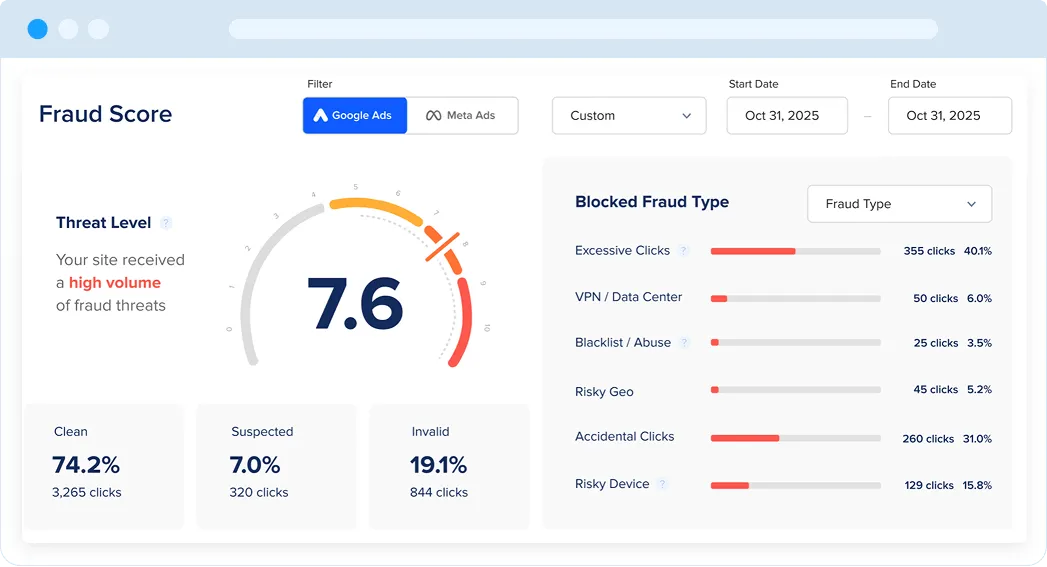 Fraud Prevention
Gain insight into which ads are actually making the phone ring. We link every call directly to the ad and location, so your budget goes primarily toward reach that actually brings in customers.
Many valuable leads prefer to call. In standard campaigns, this “offline” data remains hidden, but we make it visible through call tracking and the Money Map. We direct your budget as much as possible toward regions and keywords that lead to quality calls and revenue.
When does growth stall, or when are opportunities being missed? We often see the following indicators that call for a professional SEA approach:
We don't just look at your ads, we track behavior and movement on your pages to see exactly what works and where action is needed.
In an audit, we identify which campaigns can be improved and why.
Your "Search Lost IS (impression share, budget, or rank)" is increasing, or you're losing ground to the competition. this pattern indicates a lack of budget control or a low quality score due to poor relevance.
You're paying for irrelevant clicks. The SQR shows that "close variants" or broad-match keywords lead to waste, and negative keywords are missing.
The ROAS in Google Ads doesn't match your backend data. This discrepancy is often caused by duplicate tags, missing consent signals, or incorrect conversion windows.
Your Merchant Center has rejections or is missing essential data, such as Global Trade Item Numbers (GTIN, the product's barcode) or proper titles.
Without custom labels or the correct feed rules, the algorithm cannot perform optimally.
Bidding strategies do not move past the learning phase (“Learning Limited”) due to a fragmented budget or improper campaign structures.
Search Engine Advertising is paid per click and delivers visibility and traffic the very same day. search engine optimization (SEO) focuses on organic rankings: there are no costs per click, but it takes months to build up before results become visible.
Both channels complement each other. SEA provides immediately controllable traffic and data on which keywords convert, while SEO builds organic visibility over time. In the FAQ, you can read about how we use the two together without them canceling each other out.
We follow a structured six-step marketing process. Within this process, we use a single lifecycle framework; our sprint cadence (GROWS, SPRINT, and CLICK, described later on this page) simply determines the pace at which we carry out those steps.
A deep dive into the account, the SQR, bidding strategies, and assets. We’ll review the technical foundation: GA4, GTM, Consent Mode, and conversion mapping.
We develop a media plan that includes forecasts based on CPA and tROAS. We determine the budget allocation, match types, and audience strategy. We use Google Estimates for projections, not to follow them blindly, but to set up the Google Ads campaign so that we start with a high Quality Score right away, pay less per click than the competition, and get more impressions with the same budget.
We build campaigns in Google Ads Editor with well-structured RSA, extensions, and tracking templates (UTMs). For Google Shopping, we update the Merchant Center feeds. We don’t launch until the structure, negative keywords, tracking, and extensions are all correct, ensuring maximum relevance for the searcher before the campaign goes live.
A phased go live where we closely manage pacing and initial results. We monitor brand safety and compliance.
Continuous improvement through SQR mining, keyword expansion, asset testing, and performance-based budget reallocation. We systematically test RSA variations tailored to search intent; only combinations with demonstrably high CTR and relevance remain active. Validation is performed continuously to track increases in high-quality, sales-qualified leads, decreases in CPA, the match between search queries and landing pages, and feedback from call analyses and customer data.
The strategy doesn’t stop at checkout: we focus on Lifetime Value (LTV) through more aggressive bidding on recurring searchers (RLSA), cross-sell campaigns for existing customers, suppression lists that exclude customers from expensive generic terms, and data feedback to email and CRM workflows. This improves each cycle and structurally reduces customer acquisition costs (CAC). Reporting is done in Looker Studio with insights into cohorts, conversion paths, and gradual improvement; each month, we discuss progress and plans for the next quarter.
From the first search query to a loyal customer, guided by intent and data. We combine phases of analysis, behavior, feedback, conversion, and loyalty, with website behavior and conversion driving the analysis.
This is how we turn intent into measurable results and increase conversions.
Find your strategyEffective SEA typically starts with a strong persona, but only personas that align with actual search terms (SQR) and real-time data can scale profitably to deliver sustainable results. The key questions are: What does the searcher think, feel, see, say, do, and hear?
This persona translates psychology and search intent into a strategic foundation.
Guiding, not leading.
This persona steers based on hard results and determines where budget really delivers.
Decisive when data allows.
Hypotheses and data work side by side; the context determines which takes the lead.
A system that recognizes intent, trains bids, and boosts performance.
We use the TALL framework:
A system that gets smarter over time.
We combine BJ Fogg's theory with search behavior.
We continuously monitor the ad auction for your account.
Four steps from isolated actions to a predictable growth system.
See if we're a fitFrom search query to profit: validated, not guessed. Every optimization has one goal: more relevant visitors, lower click costs, and sustainable growth. We don’t rely on gut feelings or random keywords, but on a system in which every euro must prove its worth.
We don't launch until the basics are perfect. In Google Ads Editor, we set up structure, exclusion words, tracking and extensions. Only when the relevance for the searcher is maximized, the switch goes.
We use Google Estimates for forecasting. Not to follow blindly, but to set up the campaign in such a way that we:
Not by bidding higher, but by being more relevant.
We systematically test with ad variations (RSAs). Texts are tailored to the specific search intent and the searcher's stage.
Only the combinations that are proven to provide a high click-through rate (CTR) and relevance remain active. This way we get maximum traffic from the same media budget.
Visitors are judged on intent and true value. We look beyond the click and focus on what actually contributes to net profit.
Validation takes place continuously on:
We steer not just by first sale, but by Lifetime Value (LTV). The strategy doesn't stop at checkout.
In this way, each cycle improves and the CAC decreases over the long term.
Growth is the result of monetization, acquisition, and retention. We build this strategy from the ground up ("first principles"). The result is a self-reinforcing flywheel driven by smart design rather than luck.
Compounding growth cycles work like compound interest. Combined with strong branding, they strengthen your company’s market position.
As part of this process, we follow a set cycle of prioritizing, building, and testing every two weeks.
Let's start with clarity.
No endless processes, just execution.
To measure is to know.
We act as your full-service, senior marketing department, with direct lines of communication, in-depth expertise, and a complete focus on your bottom line.
 Google PartnerYouthCommerce is a certified Google Partner.
 GDPR-compliantFully compliant with EU privacy legislation (GDPR).
Work directly with an experienced performance marketing partner. Transparent, compliant, and results-driven.
Successful Search Engine Advertising requires the right "stack." we manage accounts with strict adherence to policy, brand safety, and privacy (GDPR and TCF). by correctly implementing Consent Mode and server-side tagging, we ensure that campaigns continue to perform consistently and measurably.
 Google Ads
 Microsoft Advertising, formerly Bing Ads
 Search Ads 360
 Google Merchant Center
 Google Analytics 4
 Google Tag Manager
 Looker Studio
 SEMrush
 Ahrefs
Companies that used to rely on gut feelings are now growing based on insight, timing, and trust.
Search engine advertising (SEA) is the fastest way to get instant results from search engines such as Google and Bing.
Search Engine Advertising (SEA) involves purchasing ad space on search engines such as Google and Bing. Advertising on Google works through bidding on specific search terms: your ad then appears at the top of the search results for users with an active intent to buy. Want to get immediate results from search engines? This is one of the fastest ways to do so, because ads are placed directly into the auction.
You pay per click, and the cost depends on your keywords, competition, and bidding strategy. We’ll work with you to set a realistic budget based on your current situation and goals. We’ll then optimize for CPA and tROAS so that every euro demonstrably contributes to increased revenue.
Measurable goals, a sufficient budget, and a functioning tracking setup (Google Analytics 4 (GA4) and Google Tag Manager (GTM)): if you have those three in place, you’re ready to get started on a solid footing. We can help you lay this foundation quickly and effectively.
Yes, this is often an effective strategy. We ensure that the channels do not “cannibalize” each other by strictly separating themes through campaign priorities and negative keywords.
Absolutely. With Consent Mode, modeled conversions, and first-party data (server-side tagging), campaigns remain measurable and controllable, even in a privacy-first world. One caveat, though: a portion of the conversions is modeled (estimated) rather than measured individually, and we report that share transparently.
Main services Varieties supporting themes Search Engine Advertising (SEA) advertising on search engines Google Ads, Bing Ads, SEA optimization professional SEA campaigns search engine Ads ROAS, CPA, CTR, Quality Score SEA services Google Ads, keyword research, negative keywords paid search results, search advertising, lead generation via search engines, sales campaigns SEA agency, search engine marketing agency, RSA ads, display ads, remarketing, search
| Main Services | Varieties | Supporting Themes |
|---|---|---|
| Search Engine Advertising (SEA) | Search Engine Advertising | Google Ads, Bing Ads, SEA Optimization |
| Professional SEA Campaigns | Search engine ads | ROAS, CPA, CTR, Quality Score |
| SEA Services | Google Ads | Keyword research, negative keywords |
| Paid search results | Search advertising | Lead generation via search engines, sales campaign |
| SEA Office | Search engine marketing agency | RSA ads, display ads, search remarketing |